Creative Assessment
Introduction
As a graphic designer and artist, creativity is at the heart of my practice. It only makes sense that creativity is at the forefront of my learning experience designs, particularly when it comes to assessment. Though traditional assessments such as standardized tests, final exams, and pop quizzes have their use, they are sorely lacking in the creativity department. Standardization (Lampland & Star, 2009) has sapped all of the creativity from assessments. It is my goal to bring creativity back to the learning environment, be it a museum or a classroom, by drawing on my personal and professional creativity when it comes to designing assessments.
Re-thinking Assessments
Techniques like backward design (Wiggins & McTighe, 2005) and ungrading (Stommel, 2018) are becoming more common techniques used to defy the restraints of traditional assessment. Backward design (Wiggins & McTighe, 2005) is a framework where learning experience designers start by determining learning objective by considering the question, “what do they want their learners to get out of the learning experience?” Then, designers create the assessment that aligns with the learning objective and measures the learners’ ability to meet the objective. Finally, with both the learning objective and assessment in mind, the designer builds learning activities that will facilitate the learning experience. This is a creative way of thinking about designing a meaningful learning experience.
Ungrading is another innovative way to re-imagine assessments. Grades have many overlooked consequences in traditional learning environments. Three challenges that arise when grades are present are 1) grades rely on the learners’ extrinsic motivation and strips them of intrinsic motivation for learning; 2) learners will take shortcuts and avoid challenges to get a good grade; 3) learners do not think critically about the content they are interacting with, they are thinking about what they need to know to get a good grade (Kohn, 2011). There are many alternatives to the widespread use of grades, one practice being ungrading. Ungrading is both a mindset and a process of challenging the traditional banking method (Freire, 2005) of education by creating an open dialogue about grades between the facilitator and learner (Stommel, 2018). Ungrading offers learners autonomy over their learning experiences (Stommel, 2018), which not only makes for more meaningful learning, builds a framework for societal change (Moore, 2025).
Creativity in Practice
As a part of my Master of Arts in Learning Experience Design, I have been tasked with designing assessments with random constraints generated by the course “sandbox,” which is a collection of ideas generated by my peers and those before us in this course. This allowed me to explore creative and unique approaches to designing assessments about graphic design. My first assessment was a venn diagram where learners could compare and contrast different graphic design principles. The learners were not allowed to use their notes, as per the structure generated by the course sandbox.
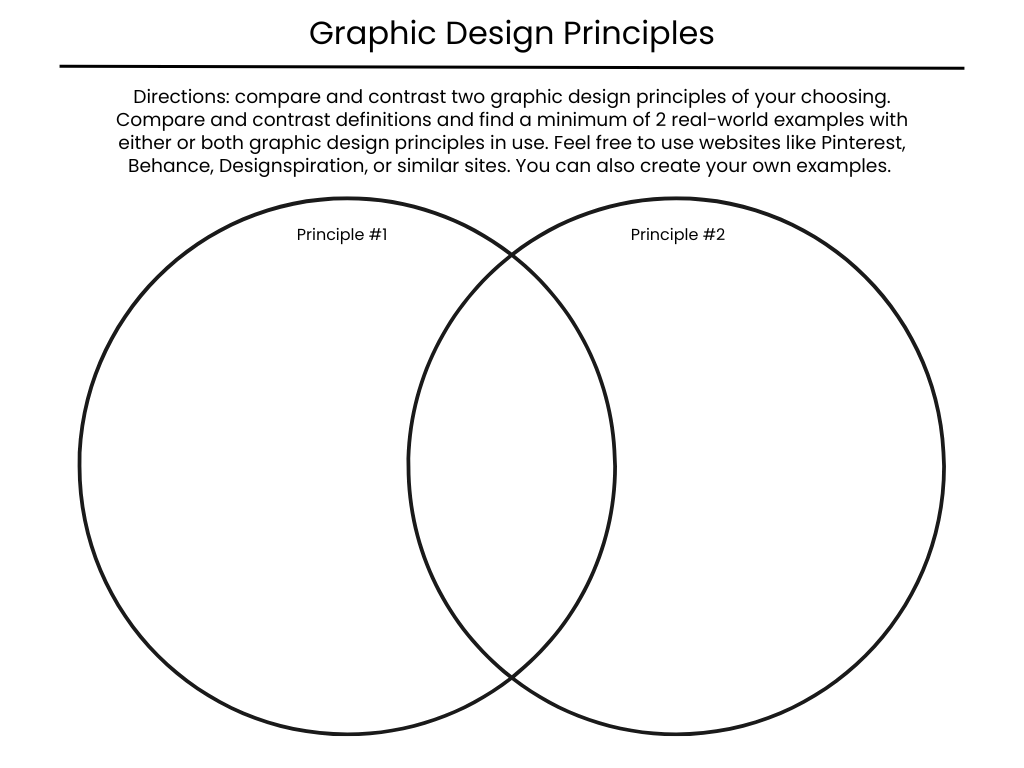
Graphic Design Principles Venn Diagram.
The learning objective was that learners will be able to compare and contrast how graphic design principles are utilized. I asked them to compare and contrast definitions and find a minimum of two real-world examples with either or both graphic design principles in use. My goal for this assessment was to either gauge their current understanding of the core graphic design principles. Directing them to find real-world graphic design examples connects what they are learning to real-world applications and ensures transferability.
This project challenged me to design an assessment framework within randomly generated constraints. I succeeded by utilizing my creativity and understanding of Backward Design (Wiggins & McTighe, 2005) frameworks by designing with the learning objective in mind. It was more important to assess the learning occurring, rather than the learners’ ability to memorize and regurgitate information. Hence, why I specified that the assessment was not for a grade. I embrace ungrading (Stommel, 2018) practices by providing meaningful and actionable feedback, rather than a meaningless letter or number grade.
References
Freire, P. (2005). Pedagogy of the oppressed. The Continuum International Publishing Group Inc.
Kohn, A. (2011). The case against grades. Alfie Kohn.
Lampland, M., and Star, S. L. (2009). Reckoning with standards. In M. Lampland and S. L. Star (Eds.), Standards and their stories: How quantifying, classifying, and formalizing practices shape everyday life, pp. 3-24. Cornell University Press.
Moore, A. (2025). Radical theory of learning. Adri Moore Design.
Moore, A. (2026). Graphic design principles. [Image].
Stommel, J. (2018, March, 11). How to ungrade. Jesse Stommel.
Wiggins, G., & McTighe, J. (2005). Understanding by design, (2nd Ed.). Association for Supervision and Curriculum Development.