Technological and Historical Impacts on My Learning Experience Design Practice
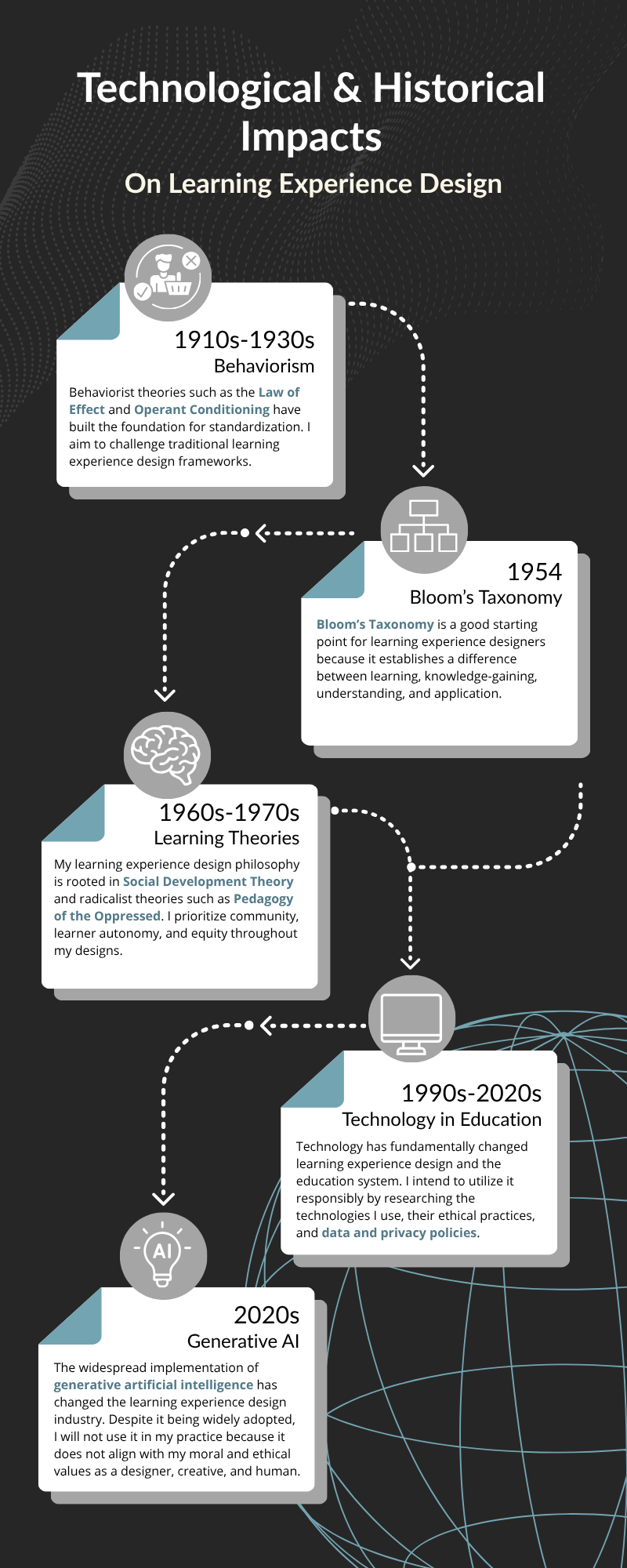
“Technological & Historical Impacts on Learning Experience Design
1910s-1930s Behaviorism: Behaviorist theories such as the Law of Effect and Operant Conditioning have built the foundation for standardization. I aim to challenge traditional learning experience design frameworks.
1954 Bloom’s Taxonomy: Bloom’s Taxonomy is a good starting point for learning experience designers because it establishes a difference between learning, knowledge-gaining, understanding, and application.
1960s-1970s Learning Theories: My learning experience design philosophy is rooted in Social Development Theory and radicalist theories such as Pedagogy of the Oppressed. I prioritize community, learner autonomy, and equity throughout my designs.
1990s-2020s Technology in Education: Technology has fundamentally changed learning experience design and the education system. I intend to utilize it responsibly by researching the technologies I use, their ethical practices, and data and privacy policies.
2020s Generative AI: The widespread implementation of generative artificial intelligence has changed the learning experience design industry. Despite it being widely adopted, I will not use it in my practice because it does not align with my moral and ethical values as a designer, creative, and human.”
Reflection
The above infographic outlines the historical and technological impacts on learning experience design. Behaviorist theories developed in the 1910s to 1930s formed the basis for standardization and traditional learning experiences by establishing a system of reward and punishment (LXD, n.d.). Bloom’s Taxonomy, developed in 1954, provided a concrete learning framework outlining goals and objectives for educators to follow (LXD, n.d.). Throughout the 1960s to the 1980s, learning theories rooted in psychology, like constructivism, Social Development Theory, Meaningful Learning Theory, and Theory of Multiple Intelligences, shaped societal beliefs around how people learn (LXD, n.d.). Technology, as we know it, started changing learning experience design in the 1990s and continues to influence the field in significant ways. These advancements include online classes, gamification, online collaboration tools, and more (LXD, n.d.). Generative Artificial Intelligence (AI) was widely adopted in the 2020s, and has forever changed the systems of learning and education.
I opted out of using generative AI for this project because of the ethical, moral, and privacy concerns surrounding its widespread use. Instead, I researched different generative AI infographic design softwares and their privacy policies. Figma (n.d.) is a popular tool used to design infographics, user experience design, website design, app design, and more. According to their frequently asked questions page, Figma (n.d.) does not use customer work to train AI data models without consent. However, they do allow third-party companies, such as OpenAI, to temporarily store customer data (Figma, n.d.). Another generative AI infographic platform is Piktochart (n.d.). Piktochart’s (2025) privacy policy centers transparency, and outlines how and why it collects user data. It states that Piktochart automatically uses content created and uploaded for their AI training data set (Piktochart, 2025).
Why does it matter if third-party organizations store consumer data, or if companies use customer work to train their generative AI models? It matters because if data and privacy are no longer secure, then people are no longer secure. At best, companies can use consumer data to manipulate people through targeted advertising into buying products. At worst, it can put people’s finances and physical safety at risk. For example, there was a data breach at a company I have no affiliation with because they were storing my data. My personal information was leaked, including but not limited to, my social security number, contact information, and home address. This led to attempted identity theft and fraudulent credit cards opened with my information. It could have been avoided if this company was not storing my data without my consent.
Generative AI models work by using creative property as training datasets, without consent, compensation, or credit to produce lower-quality content. Arguably, generative AI can be a helpful tool, but it is being used to replace human creatives entirely to boost profit margins. Its widespread use has facilitated harm against designers, authors, illustrators, animators, and so many more. It has created an era of inauthenticity and threatens humanity’s most valuable resource; creativity. I choose to take and keep the power of creativity as an intentional designer.
References
Figma. (n.d.). Building Figma AI.
Figma. (n.d.). Privacy FAQ - Figma platform.
LXD. (n.d.). A timeline of learning experience design evolution.
Piktochart. (n.d.). AI Infographic Generator.
Piktochart. (2025, August 26). Privacy Policy.